
Development of Transit-Oriented Development (TOD) Indicators for the Metro Stations of Cardenal de la Torre, La Magdalena, and El Ejido.
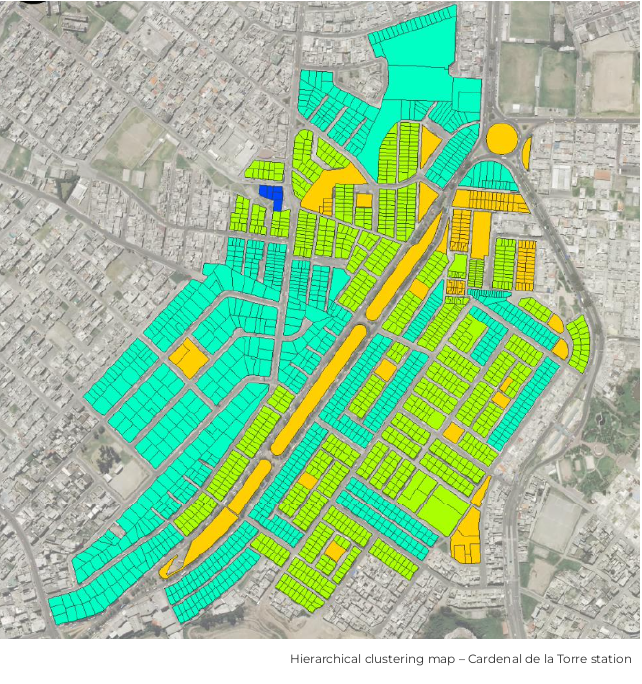
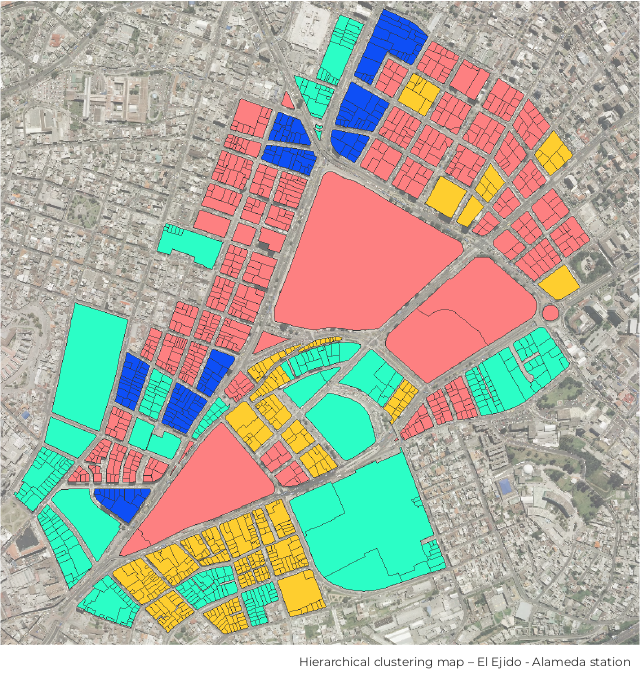
This study proposes the calculation of a Transit-Oriented Development (TOD) Index adapted to the city of Quito, using the Metro stations of Cardenal de la Torre, La Magdalena, and El Ejido as reference cases.
The methodology was structured in four stages: delineation of station catchment areas, development of 21 TOD indicators, calculation of the index, and multivariate analysis. Although the study was based on the international TOD Standard, the scoring system and weighting factors were adjusted to Quito’s local context, taking into account its irregular urban morphology, road network characteristics, service hierarchy, and the availability of local data. This adaptation enabled the index to more accurately reflect local territorial conditions, resulting in a contextualized TOD Index that supports urban planning and decision-making.
The results revealed strengths in several TOD principles, including accessibility to educational facilities, consolidated urban development patterns, and the availability of transportation options. However, significant gaps were identified in walkability, pedestrian crossings, and accessibility to services.
The multivariate analysis classified urban blocks into five distinct typologies, providing a valuable input for guiding sustainable urban planning strategies and integrated mobility policies.


If you have a research project that you would like to showcase on our geoportal, or if you are interested in collaborating on the development of a new one, please contact us!


Contact
General Inquiries
Documentation
User Support
Sponsored by:
Follow us on social media



Nuñez de Vela N35-204 e Ignacio San María
CP: S170515
Quito - Ecuador
Políticas de privacidad
All rights reserved








Urban Research and Information Center (CIIU)
Architects’ Association of Ecuador – Pichincha Province (CAE-P)